


For decades, journalists across Odisha have stood in the front line of public life—reporting floods and cyclones, exposing irregularities, highlighting the distress of farmers and migrant workers, giving voice to remote tribal communities and bringing local grievances to the corridors of power.
Yet, when the journalist himself grows old, retires or crosses 60, the support system often becomes painfully thin.
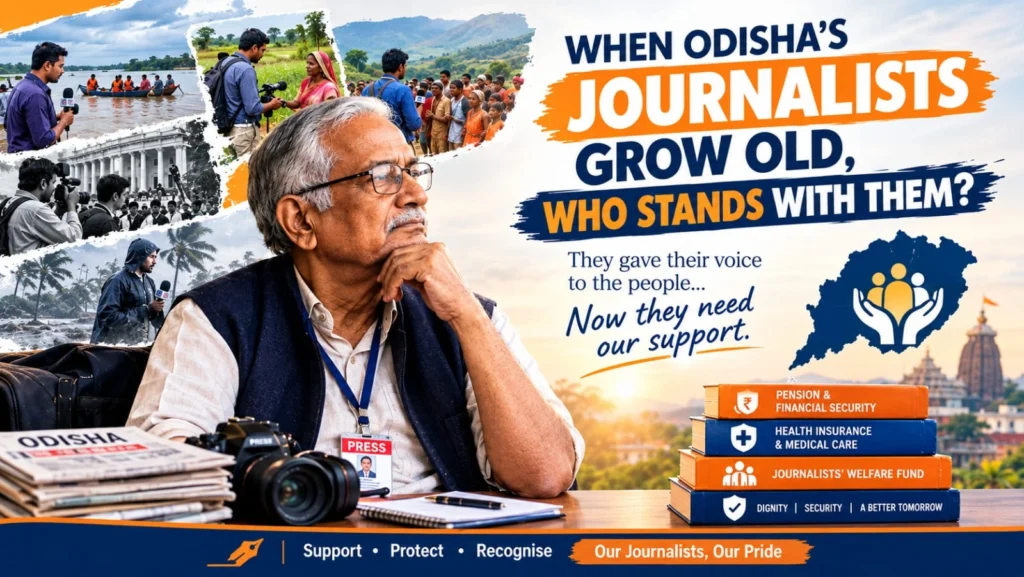
Journalism in Odisha, particularly at the district and rural levels, has largely remained a low-paid profession. Many journalists working for small and medium newspapers, local publications and news organisations have spent their productive years on modest salaries, uncertain employment conditions and without the kind of retirement benefits available to employees in the organised sector. For them, retirement is not necessarily a period of rest. It can become the beginning of another struggle.
A journalist who has spent 25, 30 or even 40 years travelling through villages, covering disasters, attending court proceedings, chasing official responses and reporting from the field may reach the age of 60 without adequate savings, pension or comprehensive medical protection. Rising healthcare costs and inflation can make old age particularly difficult for those who have no dependable monthly income. The situation demands serious attention in Odisha.
The State has a large network of journalists spread across its 30 districts, including reporters working in remote tribal, coastal and hilly regions. During cyclones, floods, landslides and other emergencies, local journalists are often among the first to reach affected areas and the first to communicate ground realities to the wider public.
But the value of journalism should not be measured only while the journalist is active. The State needs a clearly defined post-retirement social-security policy for eligible journalists.
A comprehensive Odisha Retired Journalists’ Welfare and Social Security Scheme could be considered, with a guaranteed monthly pension or financial assistance for eligible retired journalists. The scheme should also provide cashless or heavily subsidised health insurance, including support for major illnesses and hospitalisation.
The government should consider establishing a Journalists’ Welfare Fund with a dedicated annual budget rather than relying entirely on discretionary assistance. The fund could support retired journalists, journalists suffering from serious illnesses and families of journalists who die while in service.
Equally important is the need for pension portability and continuity for journalists who have worked for different newspapers or organisations during their careers. Many journalists change employers, work as correspondents or spend years in small publications. Such career patterns should not automatically exclude them from social-security benefits.
A single-window welfare board for journalists could also be established to process pension, medical assistance, education support for dependants and other welfare applications within a stipulated time.
The policy must, however, be transparent and insulated from political discretion. Eligibility, verification, benefits and grievance redressal should be clearly defined and publicly available. The system should ensure that genuine journalists—whether from Bhubaneswar or a remote block headquarters—are treated with dignity and fairness.
Journalists do not seek charity. They seek recognition for a lifetime of public service. The irony cannot be ignored: a reporter may spend his youth writing about pensioners struggling to survive, farmers demanding support, workers seeking wages and families seeking justice. Yet, years later, the same reporter may find himself standing in a queue for assistance.
Odisha has repeatedly demonstrated its commitment to social welfare and disaster management. It is now time to extend that spirit to those who spent their working lives documenting the State and its people.
Conclusion
The pen may become weaker with age, the camera may eventually be put away and the newsroom may become a memory. But the years spent serving society do not disappear with retirement. A journalist should not have to become a news story after retirement because he has no money for medicine, food or basic dignity.The State government, media organisations and journalists’ bodies should sit together and frame a durable social-security policy before another generation of ageing journalists reaches the sunset of their careers without a safety net.
The pen may fall silent one day. The State’s responsibility towards the person who held it should not.
Sunil Mohan Patnaik
President
SJAO Ganjam Unit